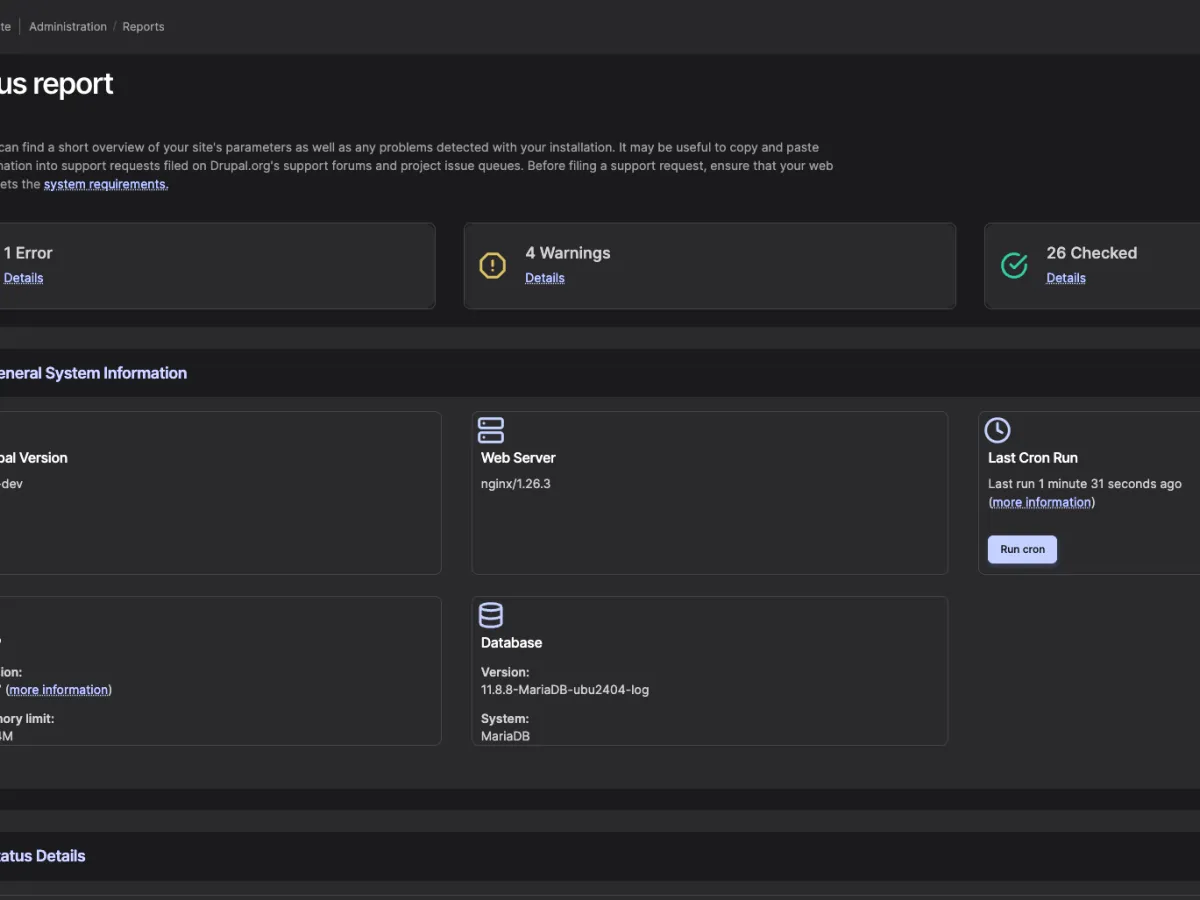
The Admin theme provides a set of CSS custom properties that modules can use instead of hard-coded colors.I manually reviewed the changes, made sure the approach made sense, and did some basic testing. Overall, it was surprisingly straightforward.This kind of CSS was common when modules needed to work across older administration themes, but dark mode changes the equation.And while you’re testing, you might even find a few bugs that are still hiding in the new Admin theme itself. If you do, please open an issue!
Dark mode is coming to Drupal core
.my-module-panel {

background: var(--admin-color-bg-surface, #fff);

color: var(--admin-color-text, #232429);

border: 1px solid var(--admin-color-border, #d4d4d8);

}
https://www.drupal.org/docs/core-modules-and-themes/core-themes/default-admin-theme/making-your-module-compatible-with-the-admin-theme-and-dark-modeThe job ended up being a little less trivial than I expected because Paragraphs still uses Sass. But Claude Code did a great job working through it and producing an MR.The Paragraphs module is a good example. It contains several hard-coded colors that look perfectly reasonable in a light administration theme but don’t work when the surrounding UI switches to dark mode.
Your module’s CSS probably needs some attention
Let’s get contrib ready for dark mode before Drupal 12 ships!For module maintainers, this means supporting dark mode isn’t really optional. Your module’s UI needs to look good regardless of which color scheme the user has enabled.That means you can add dark mode support without breaking compatibility with existing administration themes.
The fix is easier than you think!
We have documentation explaining how this works, which variables are available, and where modules should use them:Drupal’s default administration theme is changing from Claro to Admin (yes, that’s really the name). Its machine name is default_admin.background: var(--admin-color-bg-surface, #fff);
.my-module-panel {

background: #fff;

color: #232429;

border: 1px solid #d4d4d8;

}
If your module’s administration CSS contains hard-coded colors, there’s a good chance something will look broken in dark mode.To see how well this works on a real-world module, I opened the Support dark mode in Drupal 12’s new Admin theme issue in the Paragraphs issue queue.If you maintain a module that provides any administration UI, now is a great time to:But there’s one change that module maintainers should start paying attention to right now: dark mode.If you run into problems or aren’t sure how your module should handle something, feel free to reach out to me on Drupal Slack (@mherchel). I’m happy to help.
Putting it into practice
By default, Admin uses the auto color scheme. That means if a content editor has dark mode enabled in their operating system, Drupal’s administration UI will automatically use dark mode too.Admin is based on the Gin contrib theme, but includes a number of improvements and simplifications. Gin itself was based on Claro, which was forked from Seven, so there’s quite a family tree here.For example, you might have something like this:If you’re testing this now, you’ll want to test against Drupal 11.4.5 or newer, which includes the latest CSS custom property names used by Admin.One of the biggest features of the new Admin theme is built-in dark mode support.
Now is the time to test your module
And, partly to test how good the documentation is (and partly because I’m lazy), I pointed Claude Code at the documentation and the issue and told it to get to work.background: #fff;
Drupal 12 is coming this December, and it has some big changes in store for the administration UI.That’s also a pretty good sign that the documentation is doing its job: if an LLM can take an existing module with hard-coded colors, follow the documentation, and produce a solid starting point for dark mode support, maintainers should be able to make these changes without a huge amount of work.December and the Drupal 12.0.0 release are sneaking up faster than you might think.